
Chicago
Not the musical.

My family reunion in Arizona felt like the crescendo of the Ancestry.com saga. Once it was over, life picked up where it had left off. I moved to Hawai‘i full-time (after living bi-coastal for the previous four years), and the rhythm of work, relationships, and friends resumed. The revelation about my mom’s affair and my long-lost dad transformed from a shocking upheaval into a well-worn dinner party anecdote. I crafted the story into a concise, 8–10 minute flow, observing people’s reactions. Their shock diluted my own, turning an emotional furnace into something manageable, even amusing.
In those first six months, I was practically shouting the story from the rooftops, eager to process, reflect, and normalize what felt so extraordinary. I wanted to believe that everyone had a fucked-up family to some degree. Thanksgiving that year was a particularly memorable example. A notable Oscar-winning actress was at dinner, someone I’d seen in passing over the years. When she asked how I’d been, I launched into my tale. Halfway through, she interrupted, calling her teenage daughter into the room. I saw it clearly—she was twisting my turmoil into ammunition, a way to reassure herself and everyone else: “See? Chelsea’s life is a disaster compared to ours. At least I didn’t have an affair. At least you know who your father is."
This kind of voyeurism from well-meaning adults isn’t new. Since high school, I’ve noticed people peering into the chaos of my unstable household as a way to absolve themselves of their own shortcomings. It’s odd, but not bothersome. I’ve made peace with it. Still, I wanted to say, Instead of using my story to vindicate yourself, maybe go to therapy? Be introspective? Change? Her daughter saw through the charade anyway. When our eyes met, I could tell she was just as annoyed with her mother as before. I silently rooted for her.
After the initial connection with my biological family, the exchanges quickly lost momentum. I began to wonder what I wanted from these relationships. How close could we realistically be? Relationships, especially meaningful ones, require time, energy, and commitment. I sensed we were all privately deciding how much of those resources we were willing to spend. Over the next year, we shared sporadic texts, calls, and photos. Bob-dad would call late at night, often while driving home from gigs, and my sister Mia* and I started texting more regularly. For her 18th birthday, I sent her diamond huggie earrings. It felt like a big sister gesture and something I was excited to offer. I exchanged texts with my two younger brothers as well, offering encouragement when one went through heartbreak. I was genuinely excited to meet them. As the youngest in my “known” family, stepping into the role of the oldest sibling felt like uncharted territory—and I loved the idea of having brothers. I envisioned them as protectors, a source of healthy masculine energy.
In 2022, while navigating the aftermath of my most loving eight-year relationship ending, I embraced a hot girl summer of travel and transformation. One of my stops was Chicago, a city I’d only visited briefly for work years earlier. My best friend was opening a new location for her business there, so I paired her launch event with plans to meet the rest of my biological family. It felt perfect: I could support her while she supported me during my family reunion: round two.
The absurdity began immediately. Bob-dad, Mia*, and one of my brothers greeted me outside baggage claim. It was sweet to finally meet my siblings. We hugged, and Bob snapped a photo of us. I couldn’t help but laugh at how different we all looked—his kids bore their mother’s features, while I was unmistakably Bob’s daughter. The similarities were subtle but clear: our teeth, our ears.
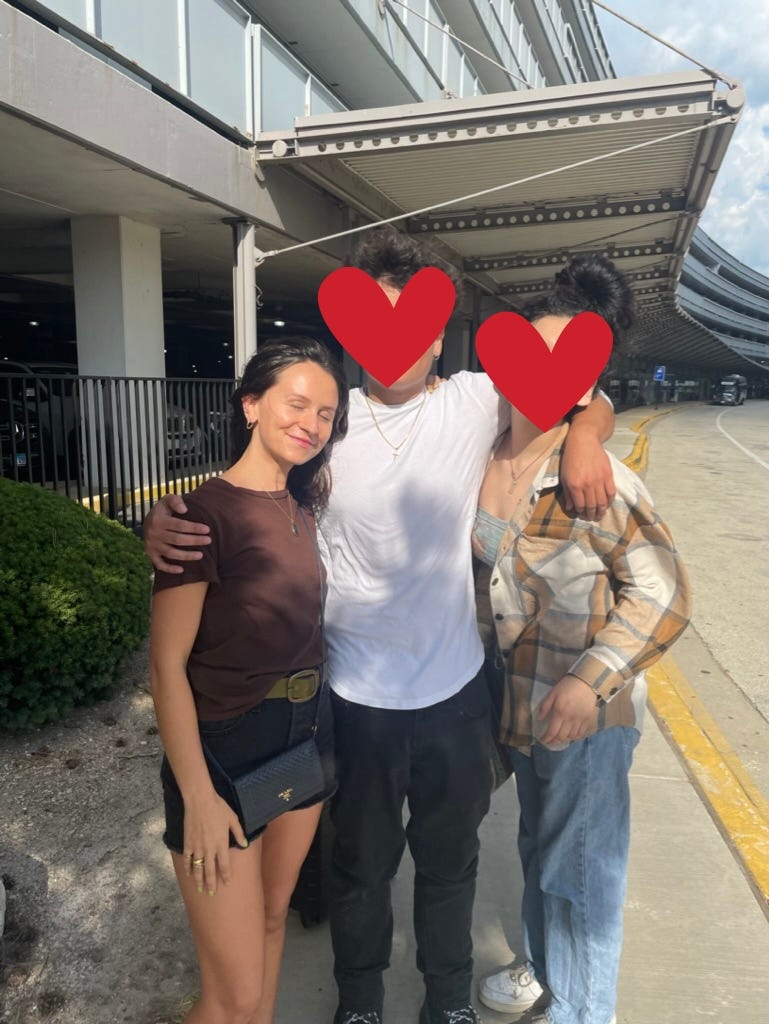
We walked to the parking garage, but no one remembered where the car was parked. After riding the elevator up and down several times, we finally found Bob’s small sedan. When I opened the trunk, it was crammed with a drum kit and golf clubs. Laughing, I joked, Should I strap my bag to the roof? Bob hurriedly removed the clubs, crammed them into the back seat, and left my siblings to sit squished beside them.
As Bob reversed the car, Mia* suddenly screamed, Stop! Sparks flew from the back wheel—it had been booted. In the 15 minutes it took him to greet me at baggage claim, he’d managed to rack up a boot. My patience was already wearing thin, but guilt tethered me to the moment. Bob sprinted off to sort it out while my siblings and I sat near the elevator. My brother offered me a small, packed bowl, and I took a quick toke to ease my agitation. Mia* abstained, explaining that sobriety was her focus after recently being released from a psychiatric hospital.
When the boot was finally removed—thanks to over $1,000 in unpaid parking tickets—we climbed into Bob’s car. The front seat was riddled with cigarette burns, and Bob, ever the charmer, asked my brother to pack him a bowl because he was “stressed.” Grabbing the pipe, I shut that down immediately. Bob protested, claiming he was the best intoxicated driver. “It wouldn’t be groovy if I ended up with two disabled or dead dads,” I quipped. My siblings chuckled knowingly, and Bob, thankfully, relented.
By the time we reached downtown, it was clear Bob had no plans—no dinner reservations, no itinerary. Starving, I Googled a nearby deep-dish pizza spot and insisted we walk there. No way were we getting back into the car. I made plans to meet them again the next night after my friend’s event.
I wanted to invite my sister, Mia*, to the opening, but she was a little rough around the edges, and I worried about introducing drama into my friend’s special evening, so I went alone. Growing up, much of my family dynamic revolved around me trying to manage the chaos of charismatic but unstable family members, delegating who could go where and under what circumstances to avoid embarrassment for them or for myself. Over time, this became more than just a coping mechanism; it became survival mode. I realize now that I’m excellent at compartmentalizing—separating parts of my life into neat boxes to maintain some sense of control amidst the chaos.
That night, as I stood at my friend’s opening, I reflected on the weight of my embarrassment. It wasn’t really about my sister Mia* or my family—it was about the impossible benchmark we’ve all been conditioned to believe in. The idea of a family that mirrors the cultural narrative of unwavering love, perfect understanding, and problems solved in the name of harmony. That hasn’t been my experience. And in many ways, my family has been chosen. My best friend expanding her business wasn’t just a moment to celebrate her; it was a moment to celebrate us. She’s my sister, my chosen family, and standing by her side that night was just as meaningful as any traditional family gathering could have been.
But the deeper truth is that I’m in the active process of what comes after individuating from my family and their chaos. I’ve spent more than half my life making choices that counter what I grew up around—choices that define who I am, what I believe, and who I want to be. I’ve poured energy and resources into understanding our shared history and creating language to process the complexities of those relationships. Now, I’m beginning the work of letting go—letting go of the responsibility to manage or caretake for others, even when their struggles with addiction or mental health make boundaries difficult to hold. It’s a frustrating reality to accept that I can’t make anyone healthy or convince them to change. Their choices are not a reflection of their love for me, nor do they define my worth. And what a relief that is.

The next day, I joined my cousins and aunt at Bob’s house before we all walked down the street to a neighborhood block party. The house had recently been rebuilt and remodeled, and I already knew the wild story behind it. Bob, in true slob-kaBob fashion, had a habit of flicking his cigarette butts onto the back steps. One day, one of those butts sparked a fire that nearly burned the whole house down—with my brother inside.
Their dog, Tesla (yes, aptly named), became the hero of the day. She barked incessantly, finally breaking through to my brother, who had been playing Xbox with headphones on, oblivious to the flames spreading through the house. When the power suddenly cut off, my brother assumed they were being robbed. He was mid-morning casual—in nothing but boxers—when he turned to look out the window and saw the flames. The door handle to his bedroom was already hot, but he made it out safely, Tesla by his side. Sprinting to the neighbor’s house, he called Bob to tell him what had happened. Bob, naturally, thought it was a prank and hung up. It wasn’t until the second call that Bob realized his house was, in fact, on fire.
After the insurance company ruled out arson, Bob received a check to rebuild and remodel. And though the near-tragedy could have been catastrophic, everyone seemed to frame it as a blessing in disguise. Apparently, the house had been in rough shape for years, a revolving door for friends, family, and partying. My brother even joked about how he had to dodge dog shit on his way out of the house that day—a fitting metaphor for the general state of things.
This wasn’t just a one-off incident; it felt like a microcosm of who Bob is. Bob’s carefree nature was evident in every aspect of his life, from the cigarette that caused the fire to the boot on his car and his casual suggestion to smoke weed while driving on the freeway. Each moment painted the same picture: a man teetering between charm and chaos, whose recklessness had shaped both his life and mine.
As I stood in his newly remodeled house, hearing the family laugh off the fire as a “blessing,” I couldn’t help but think about how this same recklessness is why I exist. A one-night stand without protection, a fleeting decision in the heat of the moment, resulted in me. There’s something profound about that—how the same impulsive tendencies that could have caused tragedy also led to life. It’s a reminder that chaos and creation often walk hand in hand.
My uncle’s wife jokingly called the house “Shangri-La” compared to its former state, while also inviting me to visit their home. “The way Bob lives,” she said, with a sly glance in his direction, “isn’t a fair representation of the family.” Bob, sitting nearby and strumming his guitar, laughed off their judgment with the same laissez-faire attitude he seemed to approach most things. It was both endearing and exasperating, the kind of charm that’s hard to resist even when it drives you crazy.
Earlier in the afternoon, I went on a drive with my brother, who surprised me by advocating for his dad. He told me how much effort Bob had put into the weekend, explaining that this wasn’t typical for him—that Bob rarely tried to make things feel special, but for my visit, he really went all out. From my point of view, I had been feeling a bit disappointed, like there was minimal care or planning for my visit. Hearing my brother’s perspective made me pause and reevaluate my attitude. It reminded me of the nuance in how we perceive each other—that what felt lackluster to me was a heavy lift for Bob. It was a humbling reminder of the layers we all carry and how easily our expectations can overshadow someone else’s effort.
Our conversation took a heavier turn when we started discussing relationships and values. At one point, he shared a hypothetical scenario that caught me off guard: if he were at the altar, ready to marry his dream girl, and found out she had once slept with someone in his groom’s party, he would leave her then and there. As he spoke, his words carried a certainty that felt borrowed, almost rehearsed—like dogma or rhetoric he’d adopted without much questioning. His perspective on women, relationships, and even abortion seemed steeped in the narrow confines of the upbringing he had known. It wasn’t just the content of his beliefs that unsettled me; it was the sense that he hadn’t yet had the space or encouragement to explore ideas outside of what had been handed to him.
As someone who has spent years unraveling inherited narratives, I felt a pull to share my own truth—not to weaponize it, but to remind him that the choices he condemned weren’t abstract. “I’ve had an abortion,” I told him, my voice steady but vulnerable. “Does that change the way you think of me? Does that make me unworthy of love or respect?” It was a moment of quiet reckoning, a chance to humanize the issue in a way his rhetoric hadn’t allowed.
For a moment, silence stretched between us. Then he pulled the car over, turned to me, and took my hand. “I didn’t mean to upset you,” he said quietly.
It was a small but significant moment. His earlier words had hurt, but this gesture—a pause, a hand held in apology—offered something unexpected: connection. It reminded me that bridging differences doesn’t require agreement; it requires presence. That conversation reminded me why I do this work—why I feel compelled to question, to share, to create space for women (and men) to reimagine what liberation and understanding can look like. Healing isn’t linear, and progress isn’t perfect, but it’s built in moments like this one: tender, imperfect, and quietly transformative.
Later that evening, we went to the neighborhood block party. It was my first time experiencing this Americana summertime ritual—corn hole, neighbors making shave ice, plenty of White Claws and malt liquor tucked in brown bags. My sister and her friend sang; Bob played drums on someone’s driveway. My best friend arrived, and together we cruised the neighborhood, meeting new people and sharing stories with my family.
As the night wound down, I realized I still hadn’t met my other brother—the one who was refusing to show up around Bob due to their recent argument. He was staying with his mom around the corner, so my friend and I decided to walk over and say hello before heading back to the city.
We sat on the stoop, talking for a while. He was sweet and sensitive, and I understood why he needed to take space to reset. It was a warm and easy exchange, and just as we were about to leave, his mom came outside. Her energy was jarring—big eyes, fast-talking, a vibe that felt off. She was polite, even kind, but something about her presence felt unsettling. Once we were in the car driving back to the hotel, my friend and I debriefed. We were both in a kind of shared shock and delirium, grateful to have experienced this together because it was hard to believe it had all actually happened.
As I reflected on the weekend, I shared my mixed emotions. I tend to respond quickly to new relationships, throwing myself in with enthusiasm and showing up without hesitation. I was excited to meet more of my family, but now I wasn’t sure if my eagerness was fueled by genuine connection or the adrenaline of it all. I told my friend I wanted to slow down, to give myself time to process everything before diving deeper into these relationships.
My position within my family has often been one of friction—calling out behaviors, pushing for acknowledgment of my reality, and fighting against the fog of gaslighting that addiction and mental health struggles bring. For years, this role left me frustrated, sometimes alienated, as I tried to force clarity into relationships clouded by denial and pain. I wanted so badly for my family to see and validate my perspective, believing that if they did, it would make me feel better. But that righteousness came at a cost. It took years of therapy and distancing myself from them to understand that empathy, even for those who hurt us, doesn’t mean abandoning our own truth.
I’ve learned how to create boundaries without walking away entirely—how to protect myself while remaining energetically open to connection. It remains a balancing act. I can hold space for myself, for my values, even when my family doesn’t meet me there. But I’ve also learned that it’s okay to walk away from toxic behaviors and fabricated realities. It’s okay to say no, to protect my sense of self, while still craving the essence of family. The interplay between empathy, boundaries, and truth has been both the greatest challenge and the clearest mirror in my life so far.
What makes it so difficult is how deeply I desire closeness with the people who raised me. Yet, I often find myself holding back, unable to sit at the table without judgment. It’s a struggle I’m determined not to repeat in my own family. My righteousness, I’ve come to see, isn’t always right. Healing from a childhood steeped in chaos and instability requires me to hold dual truths: that I can crave the essence of family while also redefining what family means for me.
I’ve sought family in my friends for as long as I can remember. In high school, I lived with various friends’ families on multiple occasions, searching for the love and stability I couldn’t always find at home. Like the lost duck in the children’s book asking every animal, “Are you my mother?” I sought belonging wherever I could. This pattern only deepens my understanding of why the closeness I felt with my dad—the man who raised me—was as profound and supportive as it was. Our bond wasn’t rooted in biology, but in choice. It makes sense now, this father-daughter love sourced from kismet rather than creation. Our relationship was a testament to what family can be when it’s built intentionally.
This weekend in Chicago underscored how much my dad’s influence shaped me and how lucky I was to have been raised in his care. He wasn’t perfect, but he was mine. His sense of style, his art collection, his love for sailing, skiing, and surfing—all of it shaped the way I see and move through the world. The clarity of this realization doesn’t diminish the complexity of my family dynamics, but it does affirm what I’ve always known in my heart: that he and I were meant to find each other. Our relationship wasn’t about where I came from; it was about where we were meant to go together.
And though the process of healing continues, I’ve realized that family—whether chosen or given—is never about perfection. It’s about presence. It’s about showing up for myself first, so I can show up for others. And as I move forward, I carry both the mess and the beauty of these relationships, letting them guide me toward a life where empathy and boundaries coexist, where the essence of family is no longer something I chase, but something I create.
*For the sake of her privacy, I’ve changed my sister’s name to Mia in this story.

So beautifully written, I resonate with much of your share, thank you for putting all the complicated emotions of navigating family into such eloquent words 🤍
Wow. You are such a gifted writer Chelsea. I’m in awe of your introspection and what you’ve learned about life from your experiences. I hope to see your work in a book one day. 🤍